For more than two decades, the humble penny has cost far more to make than it’s worth—nearly four times its face value today.
That imbalance finally caught up with it, and after 227 years, the Federal Reserve has ended penny production.
The first penny, designed by Benjamin Franklin, entered circulation in 1787. The last one was struck on November 12, 2025.
A historic milestone, certainly. But what does it mean for the everyday American?
In truth: almost nothing.
Much like the Y2K scare, the “final penny” is more headline than hardship. With an estimated 300 billion pennies still rattling around in drawers, jars, and glove compartments—and built to endure—they’ll remain part of daily life for decades, maybe generations.
No need to change your shopping habits, and there’s no reason to stockpile them. Aside from a few rare collectibles, nearly every penny will continue to be worth exactly… one cent.
Worried that rounding will drive up prices? Evidence says otherwise.
Countries that retired their smallest coin—New Zealand, Australia, Canada, Sweden—and several Eurozone nations using cash-rounding rules saw no meaningful impact on consumer costs. Here at home, the estimated U.S. “rounding tax” is about $6 million nationwide—roughly 0.0001% of our $6 trillion retail economy. In other words, barely a blip.
If you want to avoid rounding altogether, your First Education debit or credit card has you covered. Electronic transactions will continue to settle to the exact penny.
Will merchants stop accepting physical pennies?
Possibly; each business will make its own call.
But remember: ending production does not remove pennies from circulation. With billions still out there, you’ll keep using yours exactly as you always have.
Even so, this is a nostalgic moment for a coin with a remarkable history. Franklin’s original penny—pure copper, stamped with “Mind Your Business” and “We Are One”—set the stage in 1787. The first official U.S. Mint penny followed in 1793. Lincoln’s profile has watched over the obverse for 116 years, while the reverse has showcased wheat, the Lincoln Memorial, commemoratives, and today’s Union Shield.
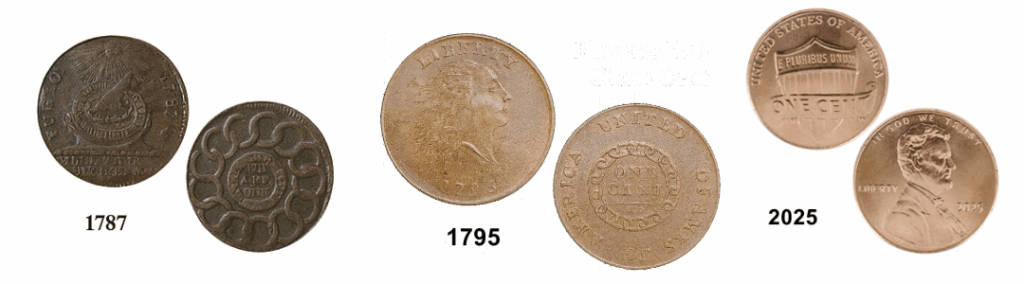
A small coin, yes—but one with a big story.
To take the official historical deep dive, visit the US Mint’s website.